Two things are true at once, and most of the argument online comes from people holding only one of them.
AI-assisted content can rank perfectly well. And an enormous amount of AI-produced content has been wiped out of search results over the past two years. Those facts are not in tension, because what was removed was not removed for being AI.
What Google's policy actually says
The relevant rule is in Google's published spam policies, under scaled content abuse. The wording is worth reading closely:
“Scaled content abuse is when many pages are generated for the primary purpose of manipulating search rankings… no matter how it's created.”
Google Search Central, Spam policies for Google web search
The same page gives, as one example of the abuse, "using generative AI tools or other similar tools to generate many pages without adding value for users".
Read those two sentences together and the position is clear. The test is purpose and value, not production method. The phrase "no matter how it's created" is doing deliberate work: a thousand thin pages written by underpaid humans breach the same rule as a thousand generated ones. Equally, an article drafted with AI and then genuinely researched, corrected and improved by someone who knows the subject is not covered by this policy at all.
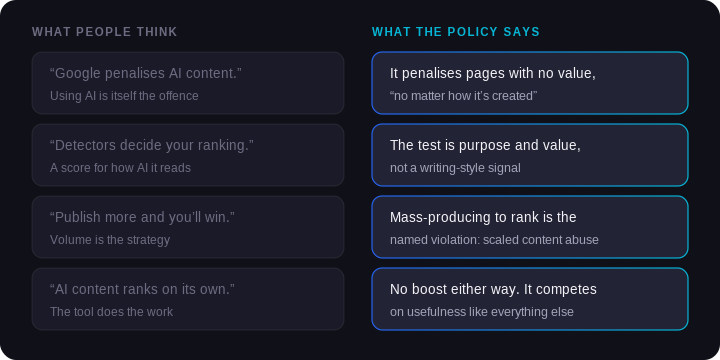
It is also worth saying what the policy does not do. It does not promise a ranking boost for human writing, and there is no published signal that scores how "AI" a piece of text reads. AI detectors are third-party products with well-documented false positives; Google has never said it uses one, and a page does not rank or fail on their verdict.
Why so much AI content did disappear: not because of a detector, but because it was published at volume, covered topics the publisher knew nothing about, repeated what was already on the first page, and added nothing. That is the definition above, almost word for word.
Where AI drafts genuinely help
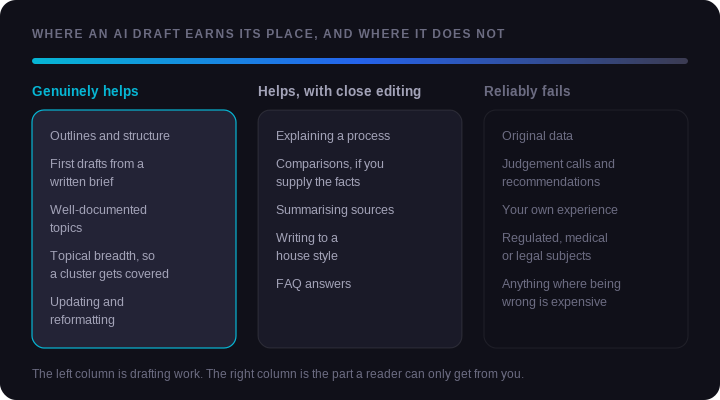
Used as a drafting tool rather than a publishing machine, AI assistance earns its place in a few specific ways.
Getting past the blank page
A structured brief in, a rough draft out. The draft is rarely publishable, but rewriting something is faster than starting from nothing, and the saving is real, perhaps a third to a half of the writing time.
Topical breadth
This is the strongest argument. If your keyword research produced twelve clusters and your budget covers three articles, nine searches stay uncovered all year. AI assistance makes covering all twelve affordable, provided each one is still checked by someone who knows whether it is true.
Updating what already exists
Refreshing figures, reworking a page for a different audience, turning a long article into an FAQ. The source material exists and is yours, so the risk of invention is low.
Where AI drafts reliably fail
These are not teething problems. They follow from what the tool is.
- Original data. It can only recombine what exists. Your own numbers, survey results or case outcomes cannot be generated, and they are the most linkable thing you own.
- Judgement calls. Ask which option suits a reader and you get a balanced summary of all options. Readers deciding between suppliers want a recommendation and a reason.
- Your own experience. The thing that makes a page impossible to copy is a sentence beginning "in our experience". That cannot come from a model, because it was never in the training data.
- Regulated, medical, legal and financial subjects. Confident wrong detail is the characteristic failure, and it is exactly the kind of mistake that is expensive in these fields.
- Anything where being wrong costs money. Pricing, specifications, compliance, safety. The editing burden here is higher than writing it properly in the first place.
The honest economics
Here is the argument nobody in this debate makes, because it suits neither side.
Suppose your budget is fixed. You can spend it on two outstanding articles, fully researched and expertly written. Or on twenty accurate, ordinary ones that cover the searches your customers actually type.
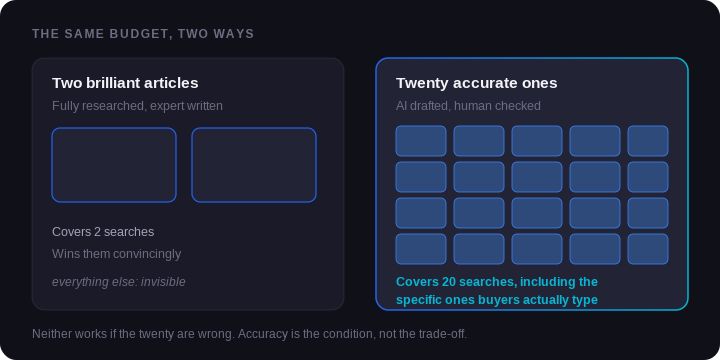
For most small businesses, the twenty win, and it is not close. Search demand is spread across a long tail of specific questions, not concentrated on two headline terms. Twenty solid pages catch twenty streams of demand. Two superb pages catch two, and compete for them against everyone else who also decided those two mattered.
This is the real case for AI assistance, and it is an economic one rather than a quality one. Nobody is claiming the drafted article is better. The claim is that twenty accurate ordinary pages beat two brilliant ones and eighteen that were never written.
But the word doing the work in that sentence is accurate. Twenty inaccurate pages are worse than nothing: they fall under the policy above, they damage trust with the readers who do arrive, and they have to be fixed later. The economics only work if the checking is real, and checking is the part people cut when they are trying to save money.
What readers notice, even when Google does not
Ranking is only half the problem. A page can rank and still lose the enquiry, and readers are better at spotting hollow writing than they are given credit for.
They may not think "this was generated". They think the page is vague, or that it did not answer the question, or that this company seems much like the last three. The tells are consistent: every option presented as equally valid, examples that could belong to any business in any country, a confident tone with nothing specific behind it, and a conclusion that restates the introduction.
None of that is unique to AI. Plenty of human-written marketing copy has the same problem, for the same underlying reason: nobody involved knew anything particular about the subject. But a draft is produced at a confident, fluent default, and fluency without substance is easy to publish without noticing.
The repair is usually small. One specific example from your own work, one number you actually measured, one sentence that takes a position. A page with three of those reads completely differently from the same page without them, and no tool can supply them for you.
The part that cannot be generated
Google's quality guidance leans on experience, expertise, authoritativeness and trust, often shortened to E-E-A-T. It is not a dial in the ranking system and nobody can optimise for it directly, but it describes what the system is trying to approximate, which makes it a useful lens.
Three of those four can be borrowed or claimed. Experience cannot. It is the one input that has to come from having actually done the thing: what goes wrong on the fifth job, what customers ask that surprises you, which of the textbook answers fails in practice.
That is also, conveniently, the part that is cheapest for you to supply and most expensive for a competitor to copy. Ten minutes of your time added to a drafted article, giving the real example and the thing you would warn a client about, is the highest-value editing any page gets.
What a sensible policy looks like
If you are deciding how to handle this for your own site, four rules cover most situations.
- Sort the work before choosing the method. Pages that turn on experience, judgement or your own data get written by a person. Explainers on well-documented topics can be drafted with assistance.
- Make a named person responsible for every page, whoever or whatever produced the draft. If nobody is willing to put their name to it, that is the signal to look at.
- Check every specific claim against a source, especially numbers, dates, prices and anything about regulation. This is where drafts fail, and it is not optional.
- Publish because there is a search to answer, never because the calendar says Tuesday. Volume without demand is how sites end up on the wrong side of the policy.
Do you have to disclose that AI was involved? Google does not require it for ranking. Some publishers disclose on principle, and some audiences expect it. The thing that matters more is the accountability behind the page: who checked it, and who stands behind it.
The short version
Google does not reward human writing. It rewards useful, accurate, original pages that answer a real question, and it has no particular interest in how they were typed. The failures attributed to AI are almost always failures of volume without value, which was punished long before these tools existed.
Use assistance where it saves drafting time on things that are already well understood. Write by hand where the value is your own judgement, experience or data. And whichever you choose, have someone who understands the subject check it before it goes out, because that step is what the policy is really testing.
Both, done properly
AI-assisted articles use a structured brief and a senior editor who checks every claim against sources, for topics where that is the right approach. Blog writing is fully human-written, for the pages that turn on experience, judgement or your own data. We will tell you which one your topic needs, including when the answer is the cheaper option.
See AI-Assisted Articles See Blog Writing