Ask any business owner to name their competitors and the answer comes quickly: three or four firms they lose pitches to, or the one down the road that undercuts everybody.
Then look at the first page of Google for the searches that matter to them, and almost none of those names appear. Instead there are directories, a trade publication, a marketplace, and two firms nobody in the business has ever heard of.
Business competitors and search competitors are different sets. They overlap a little. Analysing the wrong one is the most common way this exercise wastes a week.
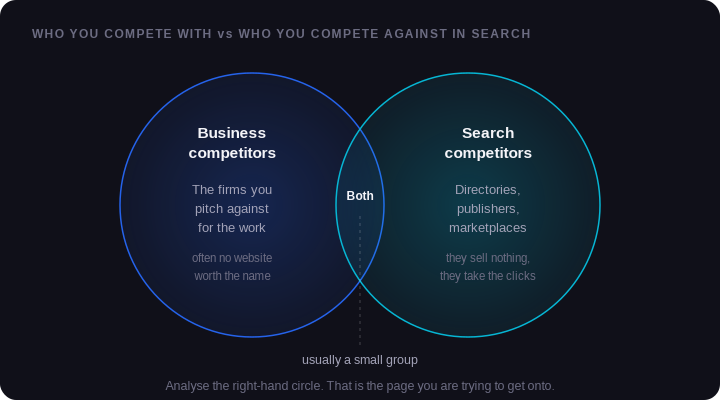
The process below takes about a day for a small site. Steps one to four need no paid tools. Step five is easier with one, and the free routes are noted where they exist.
Build the real competitor list from the results pages
Start with the ten to twenty searches that matter most to your business. If you ran the keyword research process, use your highest-scoring clusters. If not, use the searches a ready-to-buy customer would type.
Search each one in a private browsing window and write down every domain in the top ten. Do this for all of them, then count how often each domain appears.
The domains that show up across many of your searches are your real search competitors, in order of how much they stand in your way. The ones appearing once are noise. A page or two of counting beats any tool's idea of who your competitors are, because it reflects the searches you actually care about.
Sort what you find into three groups, because each needs a different response:
- Direct competitors. Businesses like yours. These are the ones you can study and beat on their own terms.
- Directories and marketplaces. Checkatrade, Yell, Clutch and their equivalents. You will rarely outrank them, so the move is usually to be listed well on them while targeting the longer, more specific searches they cover badly.
- Publishers. Trade magazines and national press. They outrank everyone on broad informational terms. Leave those alone and compete where buying happens.
Work out what each one is actually doing
Take your top three or four direct competitors and spend twenty minutes on each site. You are building a picture, not a spreadsheet.
Look at how the site is structured: do they have a page per service, a page per location, a page per industry they serve? That structure is a decision somebody made about which searches to chase. Check whether they publish regularly or stopped two years ago, and whether their pages name specific audiences or speak to everyone.
Then read their top service page as a customer would. Is the pricing visible? Is it clear who it is for? That tells you both what they are targeting and how beatable the page is.
Add site:competitor.com to a Google search to list the pages Google has indexed for them, which is a fast way to see the shape of a site. Add a term after it, such as site:competitor.com pricing, to find whether a particular kind of page exists at all.
Find their best pages
Every site has a handful of pages doing most of the work. Those are the ones worth studying.
Clues are easy to spot without any tool. Pages linked from the main navigation are the ones the business considers important. Pages they link to repeatedly from their own articles are the ones they are pushing. Pages with recent update dates are ones they are maintaining deliberately.
If you have access to a paid tool, pull their top pages by estimated traffic and read the top ten. If not, the clues above get you most of the way, and you will be reading the same pages in the end.
Find the content gap
This is where the exercise starts paying. A content gap is a topic your competitors all cover and you do not.
Make a simple table. Topics down the side, competitors across the top, and your own site as the last column. Mark who has a page for each topic.
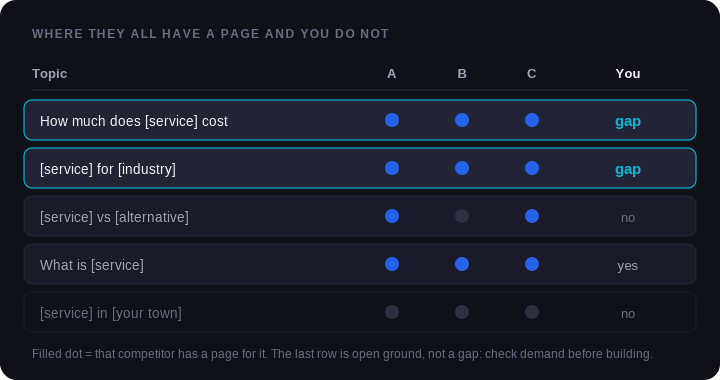
Two patterns matter. Where all of them have a page and you have none, there is almost certainly demand, and you are simply absent. Those rows are your shortlist. Pricing pages and industry-specific pages turn up here constantly.
Where nobody has a page, be careful. Open ground is sometimes an opportunity and more often a sign that nobody searches for it. Check in Search Console or your keyword list before building anything.
Also look for topics where you have a page and they have a better one. Improving an existing page is usually faster than writing a new one, and it carries whatever history the page already has.
Look at their links
Content explains part of why a page ranks. Links explain much of the rest. A page can be mediocre and still hold position one because the site behind it has earned a lot of trust over many years.
You are looking for two things. First, roughly how strong the site is overall, which most tools express as a single number, such as a Domain Rating. Second, and more useful, where their links actually come from. Trade associations, suppliers, local press, awards, partner sites, guest articles. Those are sources you can often approach yourself, because they are relevant to you too.
Most link tools are paid, but several offer a limited free tier that shows the strongest links to a domain, which is enough for this step. You can also search for the competitor's brand name in quotes to find pages that mention them, many of which link too.
Bing Webmaster Tools shows your own backlinks free, which is useful for comparison once you know what theirs look like.
Judge what you can realistically beat
Now combine what you have. For each gap on your shortlist, score the competitor currently ranking on two things: how strong their links are, and how good their page actually is.
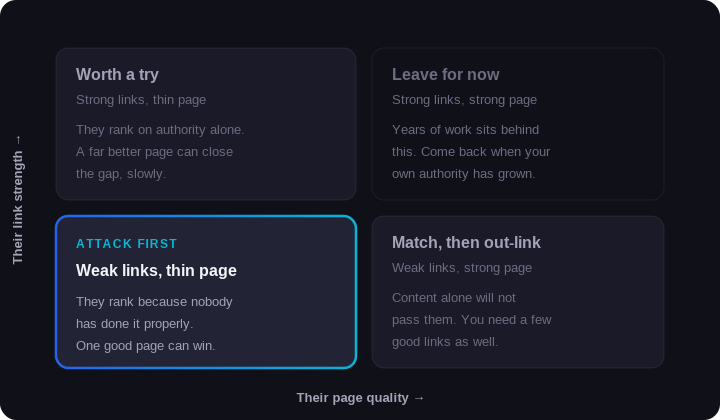
Weak links and a thin page is the quadrant to attack. Somebody is ranking because nobody has done the topic properly. One genuinely useful page can take it.
Strong links and a thin page is worth a try. Authority is holding them up, so a much better page can close the gap, though more slowly.
Weak links and a strong page means content alone will not pass them. You will need a few good links as well, which is what link building is for.
Strong links and a strong page is years of work. Note it and come back when your own authority has grown. Deciding what not to chase is as valuable as deciding what to chase.
Prioritise and write it down
Turn the shortlist into a plan: one row per page, with the topic, the competitor you are targeting, which quadrant they fall in, whether you are writing new or improving, and the order.
Order by commercial value first and beatability second. A page about pricing that one weak competitor owns beats a broad guide held by a national publisher, every time.
Keep it to the five or six pages you will genuinely produce this quarter. A list of forty is a list nobody acts on.
What this looks like in practice
A commercial cleaning company in Manchester names three rivals it loses tenders to. Searching its fifteen most valuable terms turns up a different picture.
Two of the three named rivals never appear at all: one has a single-page site, the other ranks only for its own name. The domains that do appear repeatedly are a national directory, a facilities-management publisher, a franchise with offices in twelve cities, and one independent firm nobody in the office had mentioned.
So the real list is two: the franchise and the independent. The directory gets a listing rather than a fight, and the publisher is ignored.
The gap table shows both have pages for office cleaning, school cleaning and end-of-tenancy work. The cleaning company has one page, called Services, covering all of it. That single row explains more about its traffic than any tool report would.
Checking the links shows the franchise is strong nationally, while the independent has nine links, mostly from its own suppliers. Its school cleaning page is three paragraphs long.
That page is the target: weak links, thin content, and a search with obvious commercial value. The plan that comes out of the day is four pages, starting with school cleaning, and a directory listing to tidy up. Not forty opportunities. Four, in order, with a reason for each.
How often to repeat this
Twice a year is enough for most small businesses, and after any significant change: a competitor relaunching their site, a new entrant appearing, or a drop in your own rankings you cannot explain.
Between those reviews, a lighter check works well. Search two or three of your most valuable terms once a month and note whether the names on page one have changed. New names appearing is the earliest warning you get, and it costs five minutes.
One caution worth keeping in mind: competitor analysis tells you what others are doing, not what you should do. Copying a competitor's structure page for page produces a site that is at best second-best. Use the gaps to find demand you are missing, then answer it better, and in your own words.
Want the full picture, done for you?
Keyword research and competitor analysis identifies your real search competitors, maps the content gap and hands back a prioritised build order. Where the blocker is links rather than pages, link building targets the sources your competitors already rely on.
See Competitor Analysis See Link Building