Two facts from Google's own documentation set the boundaries of this subject.
Asked how to mark a page as a featured snippet, Google's answer is two words: "You can't." There is no markup, no opt-in, no setting. Google's systems "determine whether a page would make a good featured snippet for a user's search request", and that is the entire mechanism.
What you control is whether your page makes that easy. Which, in practice, is most of the battle.
The phrase is industry jargon, not Google's. Search Console's documentation says a featured snippet "has a link to the source property, and so it (typically) occupies position 1". So winning one is not a position above the results; it is position one, presented differently.
The three types, and what each demands
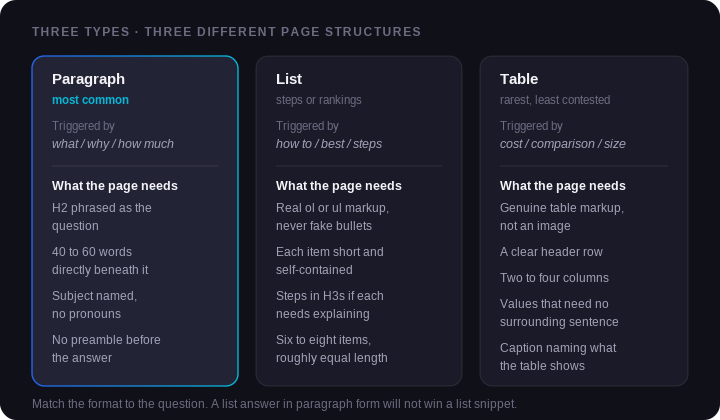
Featured snippets come in three formats, and the format is decided by the question, not by you. A "how to" query will not produce a paragraph snippet however well you write the paragraph. Matching the format is the first requirement.
Paragraph snippets
The most common by a distance, triggered by "what is", "why does", "how much" and most definition questions. They want a short, complete, self-contained answer.
List snippets
Triggered by "how to", "steps to", "best", "types of". Google builds these from real ol or ul markup, or from a run of consistent headings. Bullet characters typed into a paragraph are not a list, and will not be read as one.
Keep items short, similar in length, and self-explanatory. Six to eight works well. If each step needs a paragraph of explanation, use headings for the steps and put the detail underneath, so the heading text alone still reads as a coherent list.
Table snippets
Triggered by comparisons, price ranges, sizes and specifications. These are the rarest and the least contested, which makes them the best value on this page. Many competitors publish their comparison as a screenshot or as indented text, and neither can win a table snippet.
Use real table markup, give it a clear header row, keep it to two to four columns, and make sure each cell makes sense without the sentence that introduced the table.
The 40 to 60 word answer
Google explicitly does not publish a required length: its documentation says only that snippets appear "if enough text can be shown to generate a useful featured snippet", and that there is no exact minimum. The 40 to 60 word range is not a rule from Google; it is what fits in the space before truncation, which is why the snippets you see tend to sit in that band.
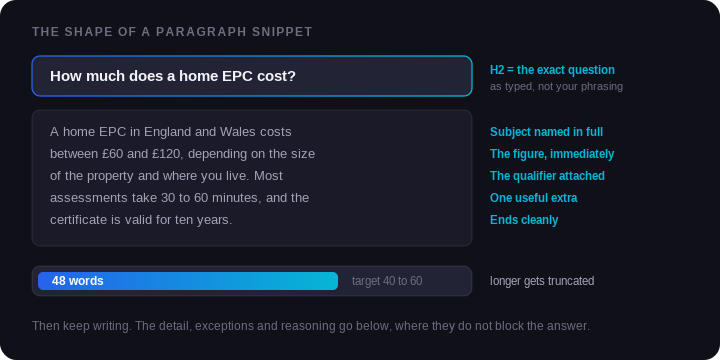
Three rules make the difference. Name the subject in full, because the snippet appears with no context. Put the answer first, with no throat-clearing before it. Stop when the answer is complete, then carry on with the rest of the article underneath, where the detail belongs.
Why the question-as-heading pattern works
Phrasing your H2 as the exact question, then answering immediately beneath it, is the most reliable structural trick in this field. It works for a plain reason: it creates an unambiguous pairing of question and answer in the page itself, so there is no guessing about which text answers what.
Use the question as people actually type it, not as you would phrase it professionally. "How much does an EPC cost?" beats "EPC pricing considerations", even though the second sounds more polished. One matches a search; the other matches a brochure.
This also makes a page capable of winning several snippets at once. Each question gets its own heading and its own short answer, so a single well-structured page can hold snippets for five or six related queries. That is why the pattern is worth applying across a page rather than only at the top.
A related benefit: the same structure feeds the "People also ask" box, which is built from the same kind of question-and-answer pairing. Pages that are organised this way tend to appear in both.
Taking a snippet from a competitor
Snippets change hands constantly, and they are one of the few things in search you can target deliberately. The constraint is simple: you must already rank on the first page. Google selects the snippet from pages it already ranks well, so if you are at position 23, this is not your problem to solve yet.
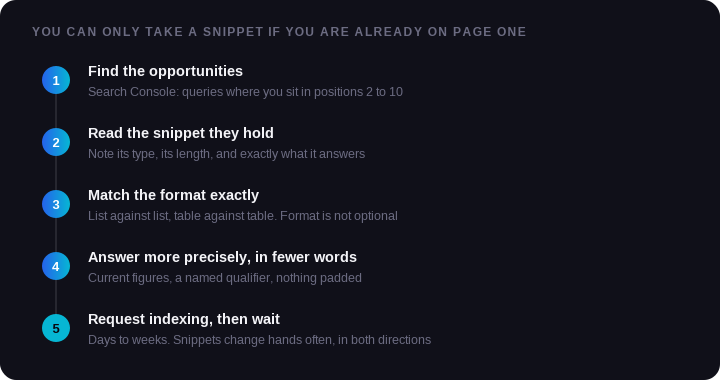
Start in Search Console. Filter to queries where your average position is between two and ten, then search each one and see whether a snippet exists and who holds it. Those are your targets, already proven to trigger a snippet.
Then read what they have. Is it a paragraph, a list or a table? How long is it? What exactly does it answer, and what does it leave out? Your job is to produce the same format, answering the same question more precisely and in no more space. If their paragraph is vague about price and yours gives a current range with a qualifier, you have a genuine case for replacing it.
After editing, request indexing and then leave it alone. Changes take days to weeks, and snippets move in both directions, so a loss next month is not necessarily something you did.
When winning the snippet costs you the click
This is the part most guides skip. A featured snippet that fully answers the question removes the reason to visit your site. You can win position one and watch clicks fall.
Whether that matters depends entirely on the query:
- Worth winning anyway: queries where the full answer needs your page, where being named as the source has brand value, or where the question is a step towards a purchase you handle.
- Think twice: simple factual lookups with no commercial value to you, where the snippet satisfies the user completely and you gain only the attribution.
If a snippet is costing you more than it returns, you have options, and they are in Google's documentation. data-nosnippet excludes specific text from being used. A lower max-snippet value discourages it, though Google warns that "using a low max-snippet setting doesn't guarantee that Google will stop showing featured snippets for your page". For a certain outcome, nosnippet is the documented solution, but it removes your ordinary search snippet too, which is a heavy price.
The more practical response is usually to change the answer rather than block it: give the complete direct answer, then make the page obviously worth opening by putting the calculator, the checklist, the regional breakdown or the worked example below it. Answer the question, then offer something the snippet cannot carry.
Why a good page still never wins one
If a page ranks well and answers the question but has never held a snippet, the cause is usually one of these.
- The answer is buried. It exists, in paragraph six, after the context. Move it under a question heading.
- The answer is too long. A 150-word paragraph gets truncated rather than chosen. Split it: short answer first, detail after.
- The format is wrong for the query. Prose where the query wants steps, or a screenshot where it wants a table.
- The page answers the same question three times, slightly differently, in three places. Pick one, make it the clearest, and cut or merge the others.
- The answer depends on a pronoun. "It usually takes two weeks" is meaningless lifted out. Name the thing.
Each of those is an editing problem rather than a writing one, which is why this work is quick on pages that are otherwise good.
A practical starting point
Pick the ten queries where you rank between positions two and ten and a snippet already exists. For each, add an H2 phrased as the question, write a 40 to 60 word answer directly beneath it, and match the format of whatever currently holds the snippet. That is a day's work and it is targeted at opportunities you already qualify for.
Do not restructure your whole site for this. Snippets are volatile, they are awarded page by page, and the work only pays where you are already competitive.
Pages restructured to answer first
Content rewriting from $60 per page adds question headings, writes the short answers beneath them and converts prose comparisons into real tables, editing in place so the page keeps its URL and its history. Voice search and schema covers the markup side, including FAQ pairing, where your page genuinely contains those questions.
See Content Rewriting See Voice Search & Schema