A plumber with twenty years of good work can sit below a two-year-old competitor in the map pack, and the usual explanation offered is that Google is unknowable.
It is not, at least not here. Google publishes what decides local ranking, and the published answer is unusually specific.
The three factors, and which one you control
Google's own guidance names three things: relevance, distance and prominence.
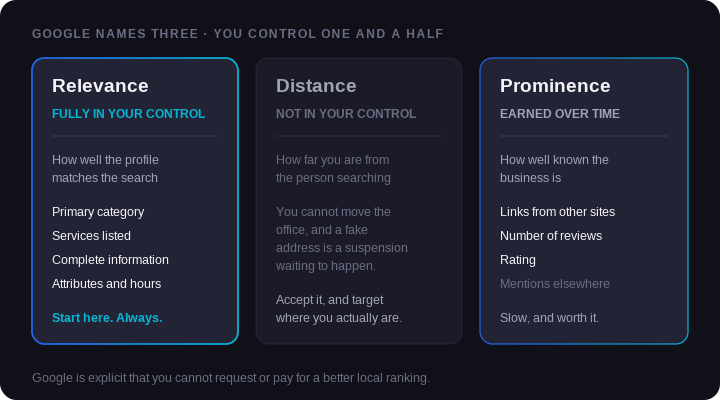
Relevance is how well your profile matches what someone searched for. Google's advice is plain: complete and detailed business information helps it understand what you do and match you to the right searches. This is the part you control entirely, and it is mostly data entry.
Distance is how far you are from the person searching. You cannot change where your premises are, and inventing an address is the fastest route to a suspended profile. Accept it: you will not rank in a town you have no presence in, and chasing that is wasted effort.
Prominence is how well known the business is. Google says this reflects information from across the web, including links, and that review count and score factor in. It moves slowly, and it is earned rather than configured.
“There's no way to request or pay for a better local ranking on Google.”
Google Business Profile help, Improve your local ranking
Worth remembering next time someone offers to guarantee you the top of the map pack for a monthly fee.
The field that decides more than the rest combined
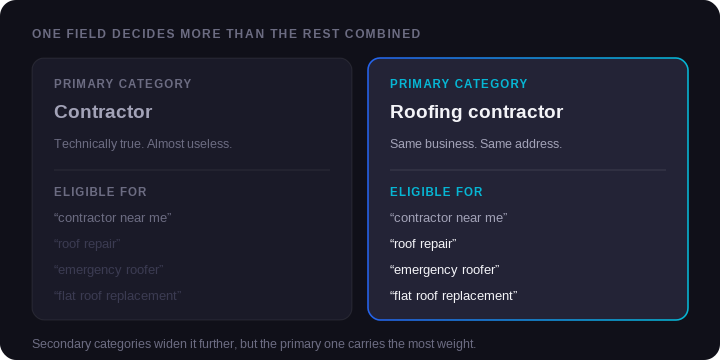
If you change one thing today, change the primary category.
It is the strongest signal of relevance on the profile, and it determines which searches you are eligible to appear for at all. Most underperforming profiles have one that is technically accurate and commercially useless.
The test is simple. Search the term you most want to rank for, in a private window, and look at the businesses in the map pack. Several tools will show you their primary category, but you can often infer it from how they describe themselves. If every one of them uses a category you do not have, that is your answer.
Pick the most specific category that genuinely describes your main service. Then add secondary categories for the other things you do, in order of importance to the business, and stop when they stop being true. Secondary categories widen the net, but the primary one carries the most weight, and stuffing irrelevant ones in dilutes rather than helps.
One caution: changing the primary category on an established profile can move your rankings in either direction while Google reassesses. Make the change deliberately, note the date, and do not change it again for at least a month.
The order to do the rest in
Everything below contributes. The sequence matters because the first two items do most of the work, and people routinely start at number seven.
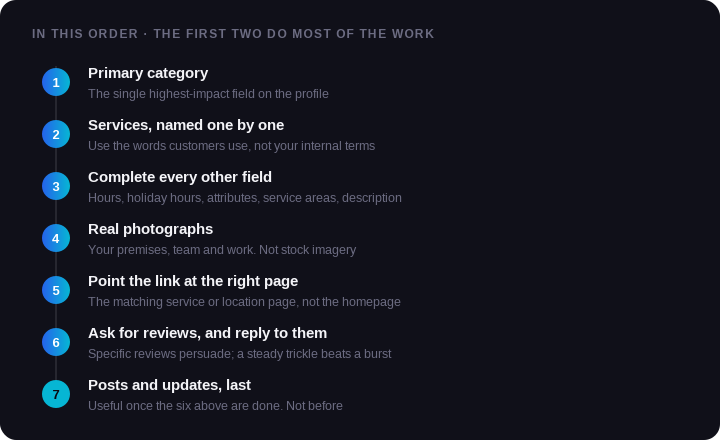
Services, named one at a time
List each service separately rather than as a paragraph, and use the words customers use. "Boiler repair" and "emergency plumber" are what people type. "Domestic heating solutions" is what the brochure says, and nobody searches for it.
Complete every field, including the dull ones
Opening hours, holiday hours, service areas, attributes such as wheelchair access or appointment-only, and the business description. Completeness is explicitly what Google asks for, and holiday hours in particular do real work, because a profile showing the wrong hours on a bank holiday costs you the enquiry and sometimes a review.
Photographs of the actual business
Your premises, your team, your work. Stock photography is obvious to customers and does nothing for you. Add new ones occasionally rather than loading forty on day one.
Point the website link at the right page
Most profiles link to the homepage by default. If you have a page about the specific service, or a location page for that branch, link there instead. It is a small change that makes the profile and the site agree about what this location does.
Reviews, with the uncomfortable parts included
Google says review count and score contribute to prominence, so reviews matter for ranking as well as persuasion. Three things follow from that, and only one of them is comfortable.
- Ask, routinely. Most satisfied customers will leave a review if asked directly and given a link. Almost none will think of it unprompted. Build the ask into the end of the job.
- A steady trickle beats a burst. Twenty reviews arriving in one week looks like what it usually is. Two a month, continuously, is both safer and more convincing to a reader.
- Reply to all of them, especially the bad ones. A calm, specific reply to a critical review does more for a prospective customer than ten five-star ratings, because it shows what happens when something goes wrong.
What not to do is more important. Do not buy reviews, do not incentivise them, and do not ask only the customers you know are happy while steering the unhappy ones elsewhere. Beyond being against Google's policies, it produces a profile full of generic five-star ratings that reads as bought, which is worse than a 4.6 with detail.
What actually gets profiles suspended
Suspension is not rare and it is painful, because reinstatement is slow and the listing disappears in the meantime. The common causes are avoidable.
- Keywords stuffed into the business name. "Smith Plumbing | Emergency Plumber Leeds 24/7" is the single most frequent cause. The name field is for your actual trading name.
- An address you do not occupy. A virtual office, a relative's house, or a coworking desk you visit occasionally. If staff are not there during stated hours, it is a problem.
- A service-area business showing a home address. If you travel to customers and do not receive them, hide the address and set a service area instead. Showing it is a policy breach, and it also publishes your home address.
- Multiple profiles for one location, often created accidentally over the years by different people. Find and merge them.
Screenshot the profile as it stands, including the category, services, hours and description. If a change goes badly you will want to know exactly what it looked like before, and the edit history is not a reliable record of that.
The page on your site that holds it up
A profile does not stand on its own. Google is matching what the profile claims against what the rest of the web says, and your own site is the most authoritative part of that.
So for each location, have a page that matches the profile: the same business name, the same address in text rather than inside an image, the same phone number, and the same services described in the same words. Link to it from the profile. If you serve several towns, that means a page per location with genuinely different content, not one page with the town name swapped.
The common failure here is a single contact page listing four branches, with the profile for each branch pointing at it. Nothing about that tells Google which branch the page is about, and the profiles end up supported by a page that is only a quarter relevant to each.
What this looks like in practice
A two-van electrical contractor in Bristol, trading eleven years, with a profile created by a previous marketing supplier.
The primary category is "Contractor". The services section is empty. The description is three sentences about commitment to quality. There are four photographs, all stock. The website link goes to the homepage. Twenty-two reviews, 4.8 average, the most recent from fourteen months ago. Hours are set, holiday hours are not.
Nothing here is broken, which is why nobody looked at it. The profile appears when people search the company name and almost never otherwise.
The work is unglamorous. Primary category becomes "Electrician", with "Electrical installation service" and "Electrical repair shop" as secondary. Eleven services are listed individually, in customer language: fuse box replacement, EICR certificate, emergency electrician, EV charger installation. The description is rewritten to say what they do and where. Twenty real photographs replace the stock ones. The link points at the new Bristol electrician page rather than the homepage. Holiday hours get set for the rest of the year.
Then the part that takes longest: asking the last thirty customers for a review, which produces nine over six weeks.
None of that is clever. It is a morning of data entry and a habit, and the profile that results is eligible for several hundred searches it was previously invisible for.
How to tell whether it worked
The profile's own performance view is the place to look, not your website analytics, because most of this activity never reaches your site.
Watch three things over a couple of months: the searches people used to find you, how many of those were for your business name as opposed to a service, and what people did next. Calls, direction requests and website clicks are the actions that matter, and they are counted separately.
The useful signal is the balance between name searches and service searches. A profile that only appears when people type your name is not working as a discovery channel yet, whatever the total impressions say. Watching that ratio shift towards service searches tells you the relevance work is landing.
Be patient with it, and expect noise. Local rankings vary by where the searcher is standing, so your own phone is a poor test instrument. Two people on the same street can see different results.
Set up properly, or kept current
Local SEO setup covers the profile end to end for a location: categories, services, the full information set, photographs and the matching page on your site. Local SEO management keeps it current afterwards, which is where most profiles quietly decay.