Every week someone emails offering 50 high-authority backlinks for a fixed fee. The pitch works because links genuinely matter and earning them genuinely is slow.
It is also a policy violation, and the honest version of this work looks nothing like the pitch.
Why links still matter
Content explains why a page deserves to rank for a topic. Links explain why your site deserves to be trusted over someone else's. That is why a mediocre page on an established site often outranks a better page on a newer one, which is infuriating and also rational: the older site has accumulated evidence that other people vouch for it.
For a small business the practical consequence is narrow. You will not out-link a national competitor, and you do not need to. You need enough that Google treats your site as a real business with a reputation, which is a much lower bar than the industry's output would suggest.
Where the line actually sits
Google's spam policies define link spam as "the practice of creating links to or from a site primarily for the purpose of manipulating search rankings", and the examples are specific.
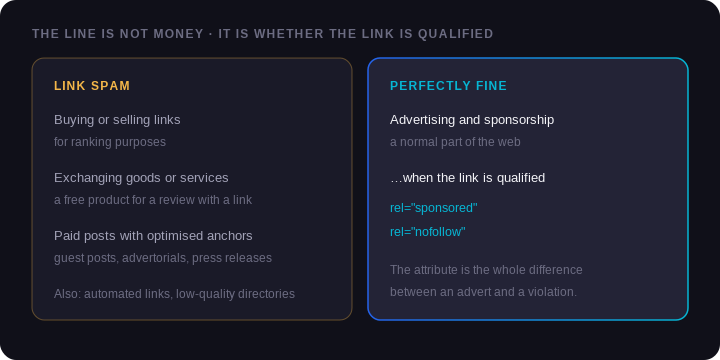
Named in the policy: buying or selling links for ranking purposes, exchanging money for links or for posts containing links, exchanging goods or services for links, and sending someone a product in exchange for coverage with a link. Also listed are automated link creation, low-quality directory links, optimised anchors in paid articles, guest posts and press releases, and links widely distributed through footers or templates.
That third one catches people out. Offering a free job, a discount or a product in return for a link is the same violation as paying cash, and it is common in trades where the money never changes hands.
The policy is equally clear about what is fine. Advertising and sponsorship are a normal part of the web, and paying for them is not a violation "as long as they are qualified" with rel="sponsored" or rel="nofollow" on the link. So you can sponsor the local football club, take an advert in a trade magazine and pay for a listing, provided the link carries the right attribute.
Would this link exist if search engines did not? If yes, it is a link. If no, and something of value changed hands to create it, it is the thing the policy describes, whatever the seller calls it.
Start with the links you already have
Before producing anything, work through the relationships that already exist. This is the least glamorous part of the subject and the highest return for a business that has never done it.
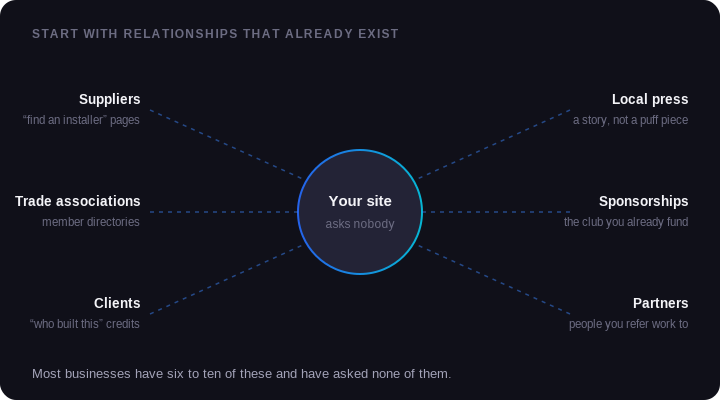
Suppliers and manufacturers. Many run "find an approved installer" or "where to buy" pages. If you are certified to fit someone's product, you may be entitled to a listing you have never claimed. This is the single most overlooked source in the trades.
Trade associations and certification bodies. You are probably already paying for membership. Check that your directory entry exists, that it links to your site rather than just naming you, and that the details match your Google profile.
Clients and partners. Firms you have worked with often credit suppliers. Ask the ones where the relationship is good, and ask for a link to the relevant service page rather than the homepage.
Things you already sponsor. The junior team, the village hall, the charity run. You funded it; the website almost certainly can list you, and that link is legitimate sponsorship.
Local press. Not a puff piece. Something that is actually a story: an apprenticeship, an unusual job, a local issue you can comment on with authority.
A couple of hours listing these honestly usually produces six to ten realistic asks. For a site with very few links, that alone changes the picture.
What actually gets linked to
Once the easy sources are exhausted, the question changes: what would make a stranger link to you?
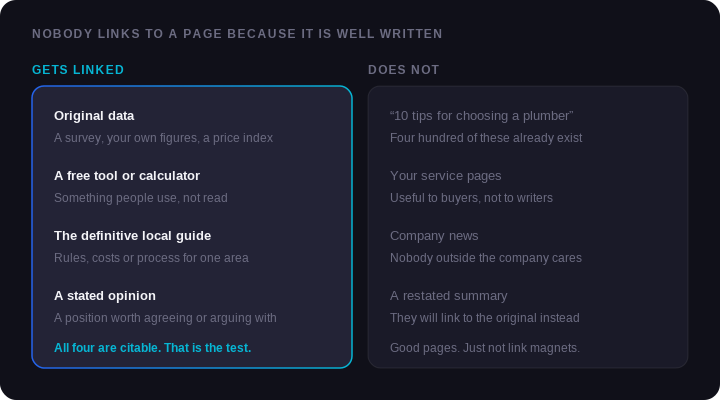
Nobody links to a page because it is well written. They link because it is useful as a reference in something they are writing.
Original data is the strongest of these and the most underused by small firms. You have information nobody else does: what you actually charged across 200 jobs last year, how long things really take, what fails most often. Published as a short annual piece with real numbers, it becomes the thing local journalists and other sites quote, and quotes come with links.
A free tool works because people use it rather than read it. A cost calculator, a sizing guide, a checklist that produces an answer. These are harder to build and keep earning for years.
The definitive local guide is the most achievable. The rules, costs, timescales and permissions for one thing in one place, kept current. National sites cover these generically and go out of date; you can be more accurate about your own area than anyone.
A clear opinion earns links because it gives people something to agree or disagree with. A page that carefully avoids a position gives nobody a reason to cite it.
Outreach, with the real numbers
The published advice makes this sound like a conversion funnel. In practice, for a small business with a genuinely useful page, sending 40 personal emails to relevant people might produce three or four links, and that is a good result.
What makes the difference is not the template. It is whether there is a reason for the person to care.
- Be specific about the page you mean. "I noticed you link to a 2021 guide on this and ours has the current figures" is a reason. "I enjoyed your blog" is not.
- Ask people who have already linked to something similar. They have demonstrated they link to this kind of thing, which is more than any other signal tells you.
- Send it yourself, from your own address, and keep it to four sentences.
- Accept silence. Most will not reply, and following up more than once converts a cold email into a nuisance.
Two things not to do. Do not offer anything in exchange, which turns a request into the violation described above. And do not mass-send: the same message to 400 addresses is spam by any reasonable definition, and it is obvious to the recipient.
What to refuse
The offers arrive constantly and some are more plausible than others.
- Packages of links at a fixed price. Whatever the wrapping, this is buying links for ranking purposes.
- Guest post networks that place articles with your chosen anchor text across sites you have never heard of.
- Paid "editorial" placements where the publication wants a fee and offers a normal link. The fee is fine; the link needs qualifying.
- Link exchanges at scale. A reciprocal link with one genuine partner is normal. A spreadsheet of them is a pattern.
- Private blog networks, which are the clearest version of the thing the policy describes.
The risk is not only a penalty. It is that you pay monthly for links on sites nobody reads, which produce no customers even when they are not discounted, and you have to clean them up later.
One guide, eleven links
A firm of chartered surveyors in Norfolk had fourteen links, nine of them from the web designer's portfolio and a defunct directory.
The asking exercise produced six: two equipment manufacturers whose approved-surveyor pages they qualified for and had never claimed, their professional body's member directory, a housing association they had worked with for years, the cricket club they sponsored, and a local business network they paid to belong to. All six existed as relationships before anyone thought about SEO. None had been asked.
The published piece was a guide to what a damp survey actually involves in older Norfolk properties: the specific construction types common locally, what each costs to investigate, what the reports usually find, and which findings mortgage lenders care about. It took a surveyor two afternoons of dictation and an editor a day to shape.
That guide picked up eleven links over about seven months. Two came from outreach to property solicitors. The rest arrived without being asked for: a regional paper covering a damp story, two estate agents' advice pages, a mortgage broker, and a national forum thread where somebody simply posted it as the clearest explanation they had found.
The useful detail is the ratio. Nine of the eleven were unprompted, which is what "earning" actually means and why the asset matters more than the outreach. It is also why this cannot be scheduled: those nine arrived when somebody happened to need a source.
A realistic first quarter
If you are starting from almost nothing, this order works.
- Month one, ask. List every supplier, association, client, partner and sponsorship. Claim the directory entries. Send the emails. Expect several to say yes without much thought, because the relationship already exists.
- Month two, build one thing worth citing. The local guide is usually the right first choice: achievable, useful to real customers, and genuinely better than the national coverage of your area.
- Month three, tell forty people it exists. Specific, personal, no incentives. Expect three or four.
That is perhaps a dozen links in a quarter. Set against the fifty promised in the email, it sounds poor, and it is the version that still works in two years.
One last note on measurement: do not judge this by a domain authority score. Those are third-party estimates, not Google's numbers, and chasing them encourages exactly the behaviour you are trying to avoid. Judge it by whether the links are from places your customers might actually be.
Or have the earning done for you
Link building targets genuinely relevant sites with real editorial standards, with no paid placements and no networks, and reports what was contacted as well as what landed. Competitor analysis is often the better starting point, because it shows where the sites above you are getting their links, and most of those sources are open to you too.
See Link Building See Competitor Analysis