Start with what Google itself says, because it saves you money.
“There are no additional requirements to appear in AI Overviews or AI Mode, nor other special optimizations necessary.”
“There's also no special schema.org structured data that you need to add.”
Google Search Central, AI features and your website
Anyone selling you an "AI Overview optimisation package" with proprietary markup is selling something Google has explicitly said does not exist. Eligibility comes from being indexed and eligible for a normal snippet. That is the entry fee, and nothing more is required.
But eligibility is not citation. Among the thousands of pages eligible to be quoted for a query, a handful get used. The difference is not persuasiveness. It is extractability.
Why extractability beats persuasion
A system assembling an answer has to take a passage from your page and place it somewhere else, where none of your surrounding context exists. If the passage only makes sense after three paragraphs of build-up, it cannot be used. If it says "our approach is tailored to each client", there is nothing in it to use.
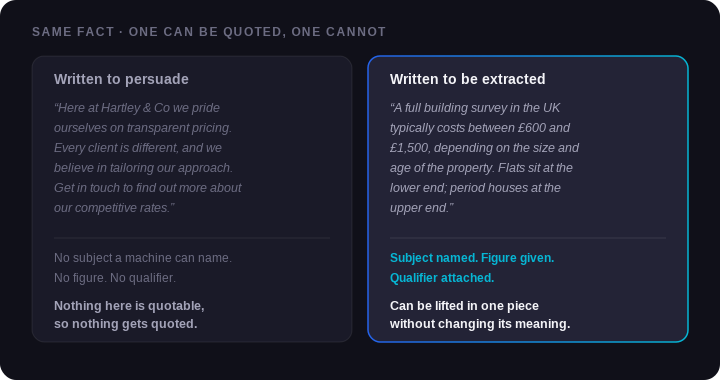
This is the whole discipline. Everything below is a way of making more of your page independently quotable, and it has a side effect worth noting: pages written this way also read better for humans in a hurry, which is most of them.
The structure that gets quoted
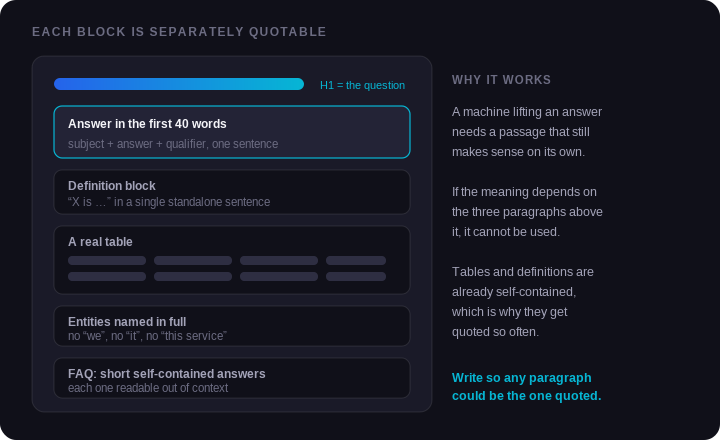
Answer in the first forty words
Put the complete answer immediately under the heading: subject, answer, qualifier, in one or two sentences. Then spend the rest of the page earning it, with the reasoning, the exceptions and the detail.
The second version can be quoted word for word without becoming wrong. The first contains no information at all.
Name entities in full
Pronouns destroy extractability. "We offer it in three tiers" is useless out of context; "HL Digital Services offers blog writing in three tiers" survives the journey. The same applies to "this service", "the above", and "as mentioned earlier".
Write the subject's full name at the start of each major section, even where it feels repetitive. It will not feel repetitive to someone who arrives mid-page from a search result, and it is the single cheapest change on this list.
Use definition blocks
Where a term matters, give it one standalone sentence of the form "X is Y". Definitions are quoted constantly, because they are already self-contained. A page explaining a concept with no clean definition sentence anywhere in it is leaving an easy citation on the table.
Use real tables
Comparisons, price ranges, specifications and timelines belong in a table, as actual table markup rather than an image or a set of indented lines. A table is structured, unambiguous and easy to lift accurately, which is exactly why these answers so often come from one.
If you publish a table as a screenshot, you have made your best material unquotable.
Answer the adjacent questions too
Look at the People Also Ask box for your target query and answer those questions on the same page, each under its own heading, each answered in its first sentence. You are widening the number of questions for which your page contains a liftable answer.
Where schema actually helps
Google has said plainly that no special structured data is needed for AI features, and the honest position is that schema is not a route into an AI Overview.
What it does do is remove ambiguity. Structured data states, in machine-readable form, what kind of thing your page is about, who published it, when it was updated, what it costs and who the author is. The relevant instruction from the same Google page is the practical one: make sure your structured data matches the visible text. Mismatches are treated as a quality problem, not a clever trick.
So use schema for what it is for. Organization and Article markup make authorship and dates explicit. Product or Service markup makes a price attributable to a specific thing rather than floating in a sentence. FAQPage markup, where your page genuinely contains those questions and answers, pairs the question with its answer unambiguously. None of this buys a citation, and all of it reduces the chance of being quoted inaccurately or not recognised as the source.
If you want the fuller treatment of markup, that is what voice search and schema work covers, and the overlap with AI search is considerable: both reward the same clarity about entities and answers.
One paragraph, rewritten
Here is a real-shaped example. An accountancy firm's page on company formation opens like this:
Nothing was invented. The second version contains facts that were already further down the page, moved to the front and written so each one survives being lifted. The first version says only that the firm exists and that the subject is complicated.
Note what the rewrite also fixes for ordinary readers. Someone who wanted the cost and the timescale now has both without scrolling, and the page is more likely to be the one they remember. The reason this technique works for AI search is the same reason it works for people: it respects the fact that the reader arrived with a question.
The rest of the original opening is not wasted. "Our experienced team has guided hundreds of businesses" belongs on the page, lower down, where it does its real job of reassuring somebody who has decided they want help. It simply should not be the first thing on a page that a search engine is reading for an answer.
What demonstrably does not work
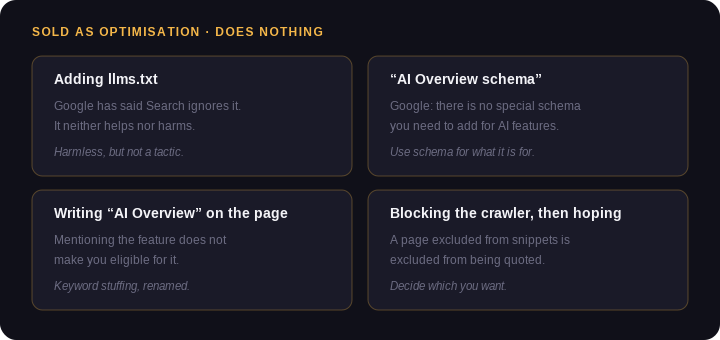
llms.txt. A proposed file listing your content for language models. Google has said Google Search ignores it, so it neither helps nor harms your rankings. Adding one is harmless; paying for one as an optimisation service is not sensible.
Special AI schema. Covered above. It does not exist.
Mentioning the feature. Writing "AI Overview" repeatedly into your copy is keyword stuffing with a new name.
Blocking crawlers and hoping. If you use nosnippet, data-nosnippet or max-snippet to limit what Google can show from your page, you are limiting what can be quoted from it in AI features too. That is a legitimate choice, and some publishers make it deliberately. What you cannot do is make it and still expect citations.
Being quoted and being clicked are not the same thing. An AI Overview can answer the question entirely, and some of your traffic will not arrive. The pages worth optimising this way are the ones where being named as the source has value in itself, or where the full answer genuinely needs your page. A pricing calculator or a booking form does not lose anything to a summary; a definition of a term might.
How to tell whether it is working
Google's documentation for the Search Console performance report is explicit about how these are counted:
- Clicks: "Clicking a link to an external page in the AI Overview counts as a click."
- Impressions: "Standard impression rules apply."
- Position: "An AI Overview occupies a single position in search results", shared by every link inside it.
In other words, this activity is already in your Performance report, mixed in with everything else. During 2026 Google has also been rolling out a separate generative AI report to some properties, reported as impressions-only and still in beta, so check whether yours has it. If not, the practical approach is the one below.
- Search your own key queries in a private window, note whether an AI Overview appears, and whether you are cited. Repeat monthly. Unglamorous, and it is the only direct evidence most sites can get.
- Watch for the signature pattern: impressions steady or rising while clicks fall on informational pages. That usually means answers are being satisfied above the results.
- Separate your page types. Compare how informational pages and commercial pages are behaving. Commercial pages are much less affected, and lumping them together hides what is happening.
- Track citation, not just traffic. If being named is the goal, count the queries where you appear in the overview, because clicks will understate the value.
Be careful with third-party tools claiming to track AI citations comprehensively. Results vary by user, location and session, so any tool's number is a sample, not a measurement.
Does this apply to the other AI search tools?
Largely, yes, and that is the reassuring part. ChatGPT's search, Perplexity, Copilot and the rest all face the same problem Google's does: they need a passage they can quote without it becoming wrong. A page written to be extractable is easier for all of them to use, so the work is not a bet on one product.
Two differences are worth knowing. First, each operates its own crawler, and your robots.txt controls them separately. Allowing Googlebot says nothing about whether the others may read your site, so if you want to be citable in those tools, check what you are currently allowing, and if you do not, check the same thing for the opposite reason.
Second, they cite differently. Some name sources prominently with visible links; others summarise more and attribute less. That changes the commercial case rather than the technique: the same rewrite serves all of them, but how much traffic returns to you varies considerably by platform, and none of them owes you a visit.
Where to start
Take the five pages that already rank in the top ten for informational queries. Those pages have proved they are relevant, which is the hard part. Then rewrite the first paragraph of each so the answer is complete in the first forty words, replace pronouns with full entity names, add a definition sentence, and turn any comparison into a real table.
That is an afternoon's work per page, it costs nothing in tooling, and it is the only part of this subject anyone can honestly promise affects your chances.
Rewritten for extraction
Content rewriting from $60 per page restructures an existing page so its answers can stand alone: answer-first openings, named entities, definition blocks and real tables, in place and without changing the URL. Voice search and schema handles the markup side, so what the page says and what it declares agree.
See Content Rewriting See Voice Search & Schema