You search your own service, your own town, and you are not there. The three businesses that are there do not look better than you, and one of them opened last year.
There are six reasons this happens. They are worth checking in a particular order, because the cheapest and most likely cause is the one almost nobody checks first.
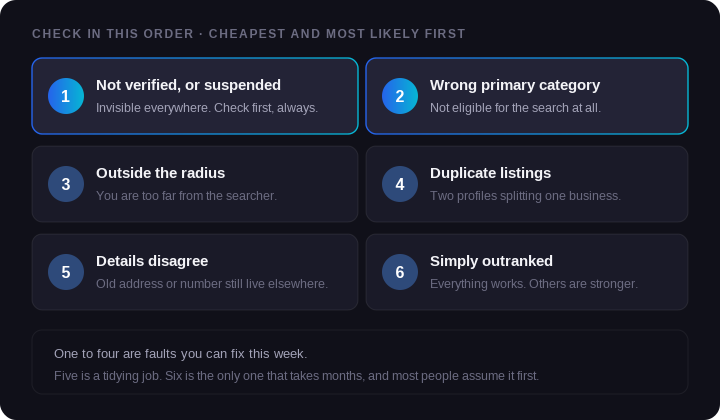
1. The profile is not verified, or it has been suspended
An unverified profile does not appear. A suspended one disappears without an announcement, and the email telling you often goes to whoever set it up years ago.
Sign in and look at the profile itself. If it says verification is needed, that is your answer and nothing else on this list matters until it is resolved. If it is suspended, there will be a notice and an appeal route.
Suspensions usually follow a recent edit. A keyword added to the business name, a changed address, switching from a service-area business to a storefront or back. If you changed something in the fortnight before it vanished, start there when you appeal.
Appeals are slow and the profile stays invisible throughout, which is why the previous article's advice to screenshot a working profile before editing it is worth more than it sounds.
2. The primary category does not match the search
Relevance is one of the three factors Google names, and the primary category is the strongest relevance signal on the profile. If it does not match what people are searching for, you are not eligible for that result in the first place.
The common version of this: a business doing one thing listed under a category describing something broader. A roofer listed as "Contractor". A physiotherapist listed as "Medical clinic". Each is technically accurate and commercially useless.
Search the exact term you want to appear for and look at who is there. If the businesses in the pack share a category you do not have, you have found the problem, and changing it is a five-minute job followed by a few weeks of waiting.
3. You are simply too far away
Distance is the second of Google's three factors, and it is the one you cannot do anything about.
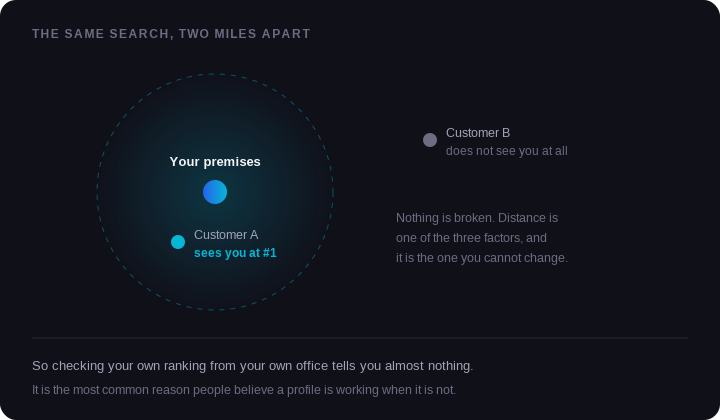
This produces the most common false alarm in local SEO, in both directions. You search from your office and see yourself at the top, so you assume everything is working. Or a customer three towns over says they cannot find you, and you assume something is broken.
Neither is evidence. The map pack is assembled around where the person searching is standing.
What follows from that is strategic rather than technical. You will not consistently rank in a town you have no presence in, and no amount of profile work changes that. If that area genuinely matters to the business, the honest options are a real location there, or competing for it through your website and paid search instead of the map pack.
4. Two profiles are splitting the business
Duplicates are more common than people expect, because profiles accumulate. One created by a former employee, one auto-generated from an old directory listing, one made by the web designer who built the previous site.
The effect is that reviews, photographs and activity are divided between them, and Google may show the weaker one or neither.
Search your business name, your old business name if you have changed it, and your address. Check Maps as well as normal search. If you find more than one listing for the same place, Google's process is to merge or remove the duplicate rather than to edit both, and the one with the reviews is usually the one to keep.
5. Your details disagree across the web
Prominence, the third factor, draws on information about your business from across the web. When that information conflicts, the picture gets less certain.
The usual culprit is a move or a number change. The new address is on your site and the profile, and the old one is still sitting on a trade directory, a chamber of commerce page, an old Facebook listing and two review sites nobody has logged into since 2021.
You do not need a hundred listings corrected. Fix the handful that matter: the directories that rank when you search your own business name, your trade association, and anywhere a customer would plausibly look you up. Make the name, address and phone number match your profile exactly, including the formatting of the address.
Services that promise to push your details to hundreds of directories are mostly selling volume. A dozen relevant, genuinely visited listings do more than two hundred nobody reads, and the cheap ones can create duplicates you then have to clean up.
6. Nothing is wrong, and you are being outranked
If the profile is verified, the category fits, the searcher is nearby, there is one listing and the details agree, then you are competing normally and losing on prominence.
That is a slower problem. Prominence builds through reviews arriving steadily, links and mentions from other sites, and the general weight of the business being known. None of it is configurable, and anyone selling you a shortcut is selling something Google says does not exist: there is no way to request or pay for a better local ranking.
The practical response is to compete where you can. Keep the review flow going rather than doing one push a year. Get listed and linked by the organisations you already deal with, which for most trades means suppliers, trade bodies and local press. And target the searches where you are strongest instead of the single most competitive term, because ranking for a specific service in your own area is both easier and more valuable than ranking tenth for the broad one.
A worked diagnosis
A dental practice in a market town rang to say they had "dropped off Google". They had not been in the map pack for about three months, and the assumption in the room was that a competitor had done something clever.
Cause one: the profile was verified and not suspended. Two minutes.
Cause two: the primary category was "Dentist", which is correct and matched everyone else in the pack. Five minutes.
Cause three: the practice is in the middle of the town it wanted to rank in. Not distance.
Cause four found it. Searching the practice name returned two listings. The second had been created eighteen months earlier, when the practice added a second surgery room and someone registered it as a separate location. It carried the same address, four reviews, and no photographs. Google had been showing that one.
The fix was a duplicate removal request, and the pack listing returned within a fortnight along with the original twenty-six reviews.
The lesson is not about duplicates specifically. It is that the first four causes took under fifteen minutes to work through, and three months of worrying about competitors had preceded them. Running the list in order would have found it on the first afternoon.
How to test this properly
Checking your own ranking badly is how most of these causes get misdiagnosed.
- Use a private window, and be aware that even then your location colours the result.
- Do not search from your own premises and conclude anything. You are the closest business to yourself.
- Ask two customers in different parts of your area to search the term and tell you what they see. This is cruder than a rank-tracking tool and more honest than your own phone.
- Check the profile's own performance view for the searches people actually used to find you, rather than guessing at the term you think matters.
And give any change a few weeks before judging it. Category changes in particular can move things in both directions while Google reassesses the profile, which is unsettling if you are checking daily.
If it is one of the first five, it is fixable
Local SEO setup works through this list for a location: verification state, categories, duplicates, and the details that disagree elsewhere. Local SEO management keeps it that way, including the review flow that prominence depends on.
See Local SEO Setup See Local SEO Management