You read the draft and something is off. It is competent. It covers the topic. It is not what you wanted, and you cannot immediately say why.
Then you look at what you sent: "Write something about pensions, about 1,000 words, by Friday." The writer delivered against that brief exactly. The gap is between what you asked for and what was in your head.
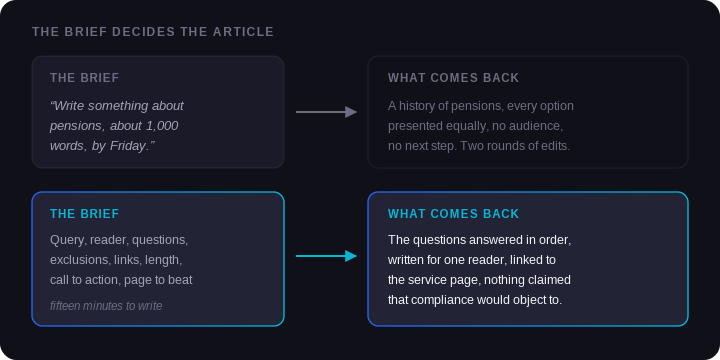
A good brief takes about fifteen minutes and saves two rounds of revisions. It also works on yourself: writing your own article against a proper brief is noticeably easier than staring at a blank page.
The eight fields
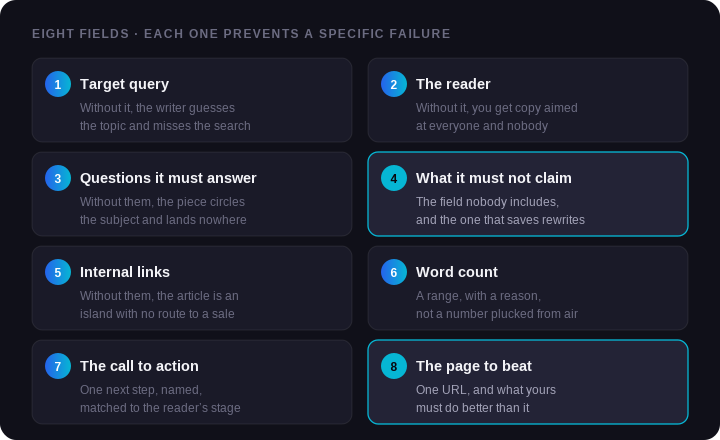
1The target query
Not the topic. The exact phrase someone types. "Pensions" is a topic and produces a textbook. InsteadTarget query: "can I take my pension at 55"
One primary query per article, plus two or three close variants. If you find yourself listing six unrelated queries, that is six articles, or at least two.
2The reader
One sentence describing one person: what they already know, what they are worried about, what stage they are at. Writing for "anyone interested in pensions" produces something aimed at everyone and useful to nobody.
InsteadReader: 52, employed, two old workplace pensions, has heard 55 is changing and is anxious about it. Not a finance professional.3The questions it must answer
Three to six questions, in the order a reader would ask them. This is the single most useful field, because it becomes the structure. If the writer answers all six clearly, the article works, whatever else happens.
Take them from your own enquiries, from the People Also Ask box, and from what competitors leave out.
4What it must not claim
The field almost nobody includes, and the one that saves the most rework. Every business has statements it cannot make: regulatory limits, promises about outcomes, comparisons with named competitors, prices that vary by case.
InsteadMust not: give personal advice, promise any specific return, say "guaranteed", or state the tax rate without the year.A writer who does not know your constraints will cheerfully write something your compliance review deletes, and the rewrite costs more than the sentence saved.
5Internal links
Name the two or three pages this article should link to, and say in what context. Without this the piece ends up as an island: it may rank, but nothing connects it to the page where somebody buys.
InsteadLink to: the pension review service page, in the section on getting advice. Link to: the earlier article on consolidating old pots.6Word count
Give a range, and give the reason. "1,200 to 1,500, because the four pages currently ranking are all around 1,400" is a brief. "1,500 words" alone is an invitation to pad.
If you do not know, say what the article has to cover and let the writer propose a length. Depth should set the count, not the other way round.
7The call to action
One next step, named, and matched to where the reader is. Somebody reading "can I take my pension at 55" is not ready to book a consultation; they might download a checklist. Asking for too much at this stage costs you the reader.
8The one page to beat
Pick one URL currently ranking for your target query and say what yours must do better. Clearer answer in the first paragraph, current figures where theirs are from 2023, a worked example where theirs is abstract.
This turns "write a good article" into a target the writer can actually aim at, and it is the field most likely to make the result genuinely competitive.
The template
Copy this, fill it in, send it. It works for a freelancer, an agency, or yourself.
CONTENT BRIEF

Working title:
Deadline:

1. TARGET QUERY
   Primary:
   Variants:

2. READER
   One sentence. Who they are, what they already know,
   what they are worried about, how close they are to buying.

3. QUESTIONS THE ARTICLE MUST ANSWER
   1.
   2.
   3.
   4.

4. WHAT IT MUST NOT CLAIM
   -
   -

5. INTERNAL LINKS
   Link to:                 in the section on:
   Link to:                 in the section on:

6. LENGTH
   Range:            Reason:

7. CALL TO ACTION
   One next step:

8. THE PAGE TO BEAT
   URL:
   Ours must be better at:

NOTES
   Tone, house style, anything the writer could not guess.
   Who to ask if something is unclear.
The same template, filled in
Empty templates are easy to agree with and hard to use. Here is the pension article briefed properly, so you can see how specific each field should be.
CONTENT BRIEF

Working title:  Can you take your pension at 55?
Deadline:       Friday 20 November

1. TARGET QUERY
   Primary:   can i take my pension at 55
   Variants:  pension access age, taking pension early, what age can
              I access my pension

2. READER
   52, employed, two old workplace pensions from previous jobs. Has
   heard the access age is changing and is worried it affects him.
   Not a finance professional. Wants a straight answer, not a brochure.

3. QUESTIONS THE ARTICLE MUST ANSWER
   1. What is the current access age, and is it changing?
   2. What happens to the money if I take it early?
   3. Does it differ between my two old pensions?
   4. What should I check before deciding anything?

4. WHAT IT MUST NOT CLAIM
   - No personal recommendation. General information only.
   - Never "guaranteed", never a specific return figure.
   - No tax figure without naming the tax year it applies to.

5. INTERNAL LINKS
   Link to: pension review service   in the section on getting advice
   Link to: consolidating old pots   where question 3 is answered

6. LENGTH
   Range: 1,200 to 1,500   Reason: the four pages ranking are 1,300 to 1,600

7. CALL TO ACTION
   One next step: download the pre-retirement checklist. Not a call
   booking: this reader is years away from deciding.

8. THE PAGE TO BEAT
   URL: [competitor article currently at position 3]
   Ours must be better at: answering in the first paragraph rather than
   the ninth, and using current-year figures rather than 2023 ones.

NOTES
   Plain English, no jargon without a definition in the same sentence.
   Ask Priya if anything touches regulated advice.
Notice how much of that is constraint rather than instruction. A writer given this does not need to ask what you meant, and cannot accidentally produce something your compliance reviewer deletes.
Using it well
Three habits make the difference between a template and a working process.
- Fill in field four properly. It takes two minutes and prevents the most expensive kind of revision, the one that happens after someone senior reads the draft.
- Send the brief before agreeing the price. A supplier who reads a real brief can quote accurately. One quoting from a title is guessing, and you will both discover that later.
- Keep the completed briefs. After a dozen articles you have a record of what you asked for, which makes it obvious which topics are covered, where the gaps are, and which briefs produced the pages that performed.
You can shorten it. For a straightforward update, fields one, three and four are enough. What you should not do is skip four and eight, because those are the two that stop a competent article from being the wrong one.
And if you are briefing a rewrite rather than a new piece, add one line: what is wrong with the current page. "Ranks on page two, answers the question in paragraph nine" tells a writer more than any amount of description of what you want instead.
Or hand us the brief
Every blog writing order starts with a brief in this format, agreed with you before anyone writes, so the first draft is aimed at the right thing. If the page already exists and underperforms, content rewriting begins by identifying what is actually wrong with it, which is the same exercise in reverse.
See Blog Writing See Content Rewriting