The advice is everywhere and it is not wrong: if you serve six towns, you need a page for each of them, because a single page mentioning all six will not rank for any of them.
What follows is usually a template with the town name as a variable. Six pages, 400 words each, identical apart from the place name and a stock photograph of a high street.
Those pages rarely rank, and at worst they are the specific thing Google's spam policies describe.
Why the usual version fails
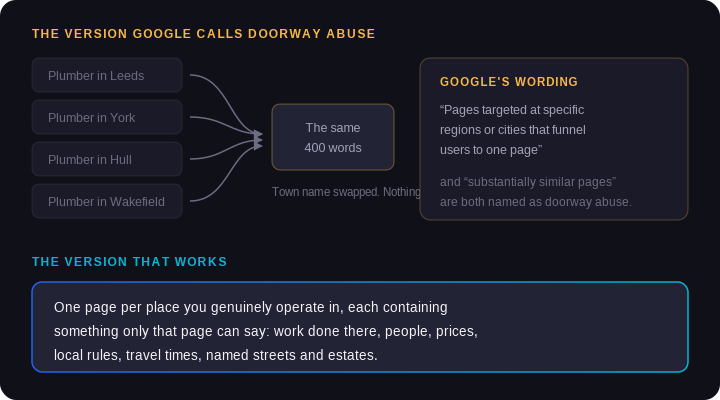
Two things go wrong at once.
The first is that the pages are substantially the same, so there is no reason for any of them to rank. Google is choosing between your Leeds page, your York page, and a competitor in York who has an office there, photographs of their van outside a job on a named street, and reviews from people in the town. Yours says "we also serve York".
The second is harder to undo: thin pages at scale make the whole site look worse. Twenty pages that nobody reads, with high bounce and no links, do not sit in a sealed compartment away from the rest of your site.
What Google actually says
This is one of the places where the policy wording is specific enough to quote.
“Doorway abuse is when sites or pages are created to rank for specific, similar search queries. They lead users to intermediate pages that aren't as useful as the final destination.”
Google Search Central, Spam policies for Google web search
Among the listed examples: "having multiple domain names or pages targeted at specific regions or cities that funnel users to one page", and "creating substantially similar pages".
Read that carefully, because it is narrower than the fear it generates. The violation is not having a page per town. It is having pages that exist only to catch a search and then push everyone into the same place, adding nothing on the way.
Which gives you a usable test. If a visitor landing on your Wakefield page gets something a visitor landing on your Leeds page does not, you are fine. If the Wakefield page is a turnstile, you are not.
What makes a location page genuinely different
The answer is not more words. It is information that could only appear on that page.
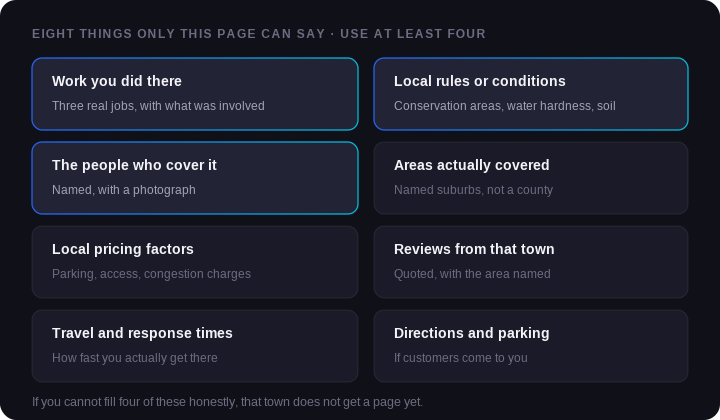
Work you have actually done there. The strongest ingredient by a distance. Three real jobs, briefly described: what the problem was, what you did, roughly what it cost. No two towns produce the same three jobs.
The people who cover that area. Named, with a photograph. "Your Wakefield jobs are usually done by Mark, who has covered the area for nine years" is both reassuring and impossible to template.
Local pricing factors. Parking restrictions, access problems, congestion charges, longer travel. If it changes the price or the timescale, say so.
Local conditions and rules. Conservation areas, water hardness, clay soil, a council with its own permit process. This is where trades have far more to say than they realise.
The areas you genuinely cover, named as residents name them, rather than a county.
Reviews from that town, quoted with the area named.
Notice that none of this is writing. It is extraction: the information exists in the business already and has never been written down. An hour with whoever runs the diary produces most of it.
Which towns actually deserve a page
Fewer than you have been told. The instinct is to build one for every place within an hour's drive, and that instinct is what produces the thin pages.
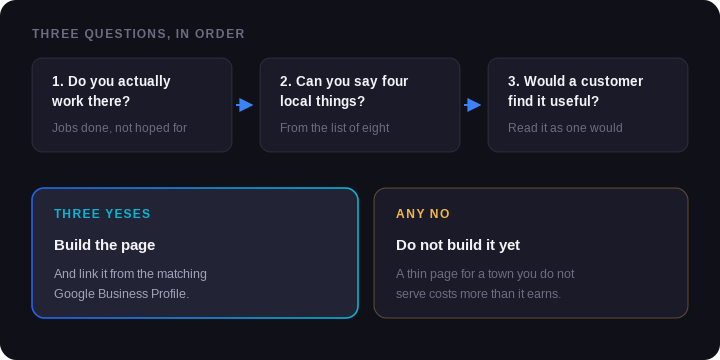
Work through the questions honestly. Do you genuinely work there, with jobs completed rather than hoped for? Can you supply four of the eight ingredients? Would a customer from that town find the page useful on its own terms?
For most small businesses this produces three or four pages, not fifteen. That is the right answer, and the remaining towns are something to earn later: once you have done work in Harrogate, the Harrogate page writes itself.
Service-area businesses with no premises in those places are the hardest case, and the honest position is that you are competing at a disadvantage in the map pack however the page is written. The page can still earn ordinary search traffic, but it needs to be genuinely about the area rather than a claim to be in it.
How to structure one
A page that works tends to follow the same shape.
- Heading with the service and the place, as people type it. "Emergency plumber in Wakefield", not "Wakefield Division".
- The answer in the first forty words: what you do, where, how fast you get there, and how to start. Somebody who reads only this should be able to act.
- The local proof: the jobs, the people, the areas covered.
- The specifics that differ here: pricing factors, access, local rules.
- Reviews from that area.
- One clear call to action, with a phone number that is tappable.
Then link it properly. Each location page should be reachable from your main navigation or a services index, not only from a sitemap. And the matching Google Business Profile for that location should point at this page rather than your homepage, so the profile and the page agree about what exists there.
On length: 600 to 900 words of real information beats 1,500 words of padding. The word count is a consequence of having something to say, not a target.
What this looks like in practice
A pest control firm covering a city and four surrounding towns had five pages, each about 350 words, differing only in place names. None ranked beyond page three, and the pages had been live for two years.
The rebuild started with a conversation rather than a keyboard. Forty minutes with the two technicians produced more usable material than the previous agency's entire template: squirrels are the common job in one town because of a particular stretch of woodland, a conservation area in another restricts what can be fixed to the outside of listed buildings, one town has a council scheme that affects who pays, and the fifth is mostly new-build estates with a completely different set of problems.
Each page then had something true that only it could say. Two of the five were deleted, because the firm had done four jobs in those towns in two years and could not honestly fill a page. Three remained, at roughly 800 words each.
The pages that stayed began ranking on the first page for their town within about four months. The interesting part was the two that were deleted: traffic to the rest of the site did not drop, and the firm stopped getting enquiries from an area it could not profitably reach anyway.
How to tell whether they are working
Location pages are easy to measure, because each one targets a named place and you can filter by it.
In Search Console, look at each page individually rather than the site as a whole. The question is whether the page is appearing for queries containing its town name, and where it sits for them. A location page ranking for its service but not for its place name is not doing its job, whatever its total impressions say.
Give them longer than you want to. A new location page typically takes two to four months to settle, and the first signs are impressions rather than clicks: you appear, low down, for a handful of local queries, then move up. Judging at six weeks is how good pages get deleted.
Two warning signs worth acting on. A page with impressions but almost no clicks usually means the title and description do not say the place clearly enough. A page with neither, after four months, usually means the content is still too generic, and the honest fix is more local substance rather than more words.
The mistakes worth naming
- Spinning the text. Rewriting the same paragraph in slightly different words is the template problem with extra steps.
- Inventing an address. A virtual office to justify the page risks the Google profile for that location, which is a much bigger loss than the page.
- Building pages for towns you cannot reach. Enquiries you have to turn down cost time and produce bad reviews.
- Stock photography of the town. A generic image of a high street adds nothing. A photograph of your own van on a job there adds a great deal.
- Hiding them in the footer. Fifteen town links crammed into the footer is a recognisable pattern, and it is not how a genuine page gets linked.
The underlying rule is simple enough to apply without any knowledge of search: build the page if you have something to say about that place, and do not if you do not. The policy and the customer want the same thing here, which is not always true in this field.
Built properly, for the places you actually serve
Local SEO setup covers a location end to end, including the page that supports its Google Business Profile, so the profile and the site agree. If the pages already exist and read like a template, content rewriting from $60 per page rebuilds them around what is genuinely local, in place and keeping the URLs.
See Local SEO Setup See Content Rewriting