Around 2018, a great deal was written about voice search. Half of all searches would be voice by 2020. Businesses would need to rebuild their content for speech. Agencies sold voice search packages.
That did not happen in the way it was described, and most of the advice written then is still being recycled now.
This article tries to be straight about it: what is genuinely different about voice, what is ordinary SEO being resold, and where the real version of this opportunity has moved.
Why it was oversold
The overstatement came from a real observation stretched past what it supported. Voice assistant use did grow quickly. The leap was in treating "people talk to devices" as "people search by voice instead of typing", when most assistant use turned out to be timers, music, messages, alarms and smart home controls — not queries that could send anyone to a website.
Then the forecasts got repeated without their sources. The widely quoted "50% of searches will be voice" figure has been cited for years with the original research either unidentified or not saying what it was claimed to say. Be suspicious of any voice statistic you cannot trace to a published methodology, including any in articles selling you voice optimisation.
None of which means it does not matter. It means the honest version is smaller and more specific than the pitch.
What does not change
Worth saying plainly, because it is most of the subject.
A spoken query goes into the same index and is answered by the same ranking systems as a typed one. There is no separate voice index, no voice ranking factor, and no setting that opts a site in. A page that ranks well and answers clearly is a page that can be read aloud. A page that does neither will not be rescued by voice-specific work.
So the foundations are unchanged: relevance, a page that loads, a clear answer near the top, and — for the local queries that make up much of voice — an accurate business listing.
Sold as voice optimisation
Write conversational content. Use natural language. Answer questions directly. Improve page speed. Add FAQ sections.
What that actually is
Featured snippet optimisation, which you should be doing anyway, repriced. Useful advice. Not voice advice.
The three things that genuinely differ
Strip out the recycled material and this is what is left.
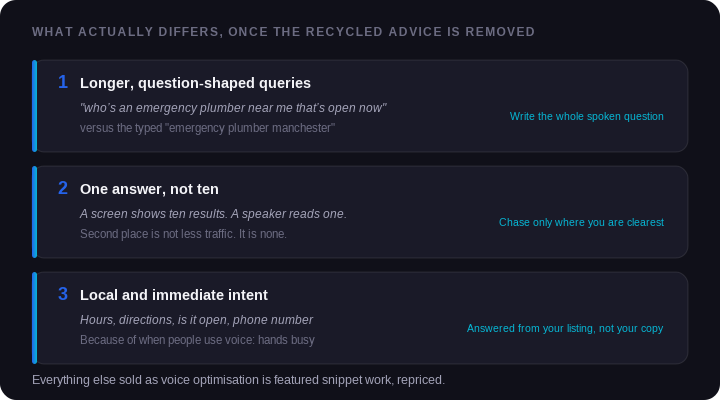
1. Queries are longer and phrased as questions
People type "emergency plumber manchester". They say "who's an emergency plumber near me that's open now". The spoken version carries more words, more grammar and more context.
The practical consequence is about phrasing rather than technique. Content built around the full question as someone would say it matches more of these queries than content built around a two-word keyword. This is the same advantage that wins featured snippets, which is why the advice overlaps — but the queries themselves really are different, and keyword tools under-represent them because few people type them.
2. There is usually one answer, not ten
This is the genuinely hard part. A screen shows ten results and a user chooses. A speaker reads one. Second place is not a smaller amount of traffic; it is nothing.
That changes the economics. For a term where you are realistically third or fourth, voice is not a channel you can win, and effort aimed at it is better spent elsewhere. For a term where you are already the clearest answer, voice is a bonus you get for free.
3. Intent skews local and immediate
Voice queries are disproportionately about things nearby and things needed now — opening hours, directions, whether somewhere is open, phone numbers. That is a consequence of when people use voice: driving, cooking, walking, hands occupied.
This is the most actionable of the three, and the least technical. It is almost entirely about your business listing being correct.
Speakable markup, honestly
Most voice optimisation proposals include speakable structured data, which marks the sections of a page suitable to be read aloud. It sounds exactly like the thing this article should recommend.
Google's own documentation is unusually blunt about its limits. The feature "is in beta and subject to change". And on availability: the speakable property "works for users in the U.S. that have Google Home devices set to English, and publishers that publish content in English".
Read that scope again
U.S. users, Google Home devices, English, and framed throughout Google's documentation around news content and topical news queries. For a business outside the U.S., or one that is not a news publisher, speakable markup is unlikely to do anything at all. It is not harmful. It should not be the centrepiece of a quotation.
If someone has proposed speakable markup to you as a significant deliverable, that is a fair question to put to them: which users, on which devices, in which country, will see the benefit? The answer is in Google's documentation and it is narrow.
The local concentration, which is the real work
If you take one thing from this article: for most businesses, voice search optimisation is local SEO with a different label on the invoice.
When someone asks an assistant for a service near them, the answer is assembled from business listing data — name, address, phone, hours, category, reviews — far more than from your website's copy. Which means the work that pays is unglamorous:
- Claim and verify your Google Business Profile, and keep the hours accurate including holidays. "Is it open now" is one of the most common voice queries there is, and it is answered from that field.
- Make your name, address and phone number identical everywhere they appear. Inconsistency across directories is the most common cause of a listing being trusted less.
- Pick the most specific primary category available, not the broadest.
- Keep reviews coming in steadily, since assistants frequently qualify a recommendation with a rating.
- Put the same details on your own location page in plain text, and mark them up with LocalBusiness schema so there is no ambiguity.
None of that is voice-specific, which is rather the point. Done properly, it is also most of what wins you the map pack and the "near me" results on screens.
Where the growth actually is
Here is the part that matters more than anything above.
The behaviour voice search was predicted to create — ask a question, get one synthesised answer, never see a list of links — has arrived. It just did not arrive through speakers. It arrived through AI assistants and AI answers in search, where people type the question and receive an answer assembled from sources.
That is the single-answer problem at scale, and it is growing fast, while the speaker-based version stayed niche.
The useful consequence is that the work overlaps almost entirely. Pages that answer a specific question clearly, state facts in a form that can be quoted, and are unambiguous about who said what are the pages that get cited in an assistant's answer. That is the same shape as the page that would be read aloud, and it is covered in the AI Overviews article from earlier in this series.
So: do the work, but understand what you are doing it for. You are not optimising for smart speakers. You are making your pages quotable, which pays off in a much larger place.
What to actually do
In order of return:
- Fix your business listing. Hours, category, address, phone, reviews. If customers come to you, this is the entire first tier and it costs nothing but attention.
- Write question-shaped headings and answer them immediately. The exact question, as spoken, with a short complete answer underneath. This wins snippets, feeds AI answers, and covers the longer spoken queries all at once.
- Add LocalBusiness and Organization schema. Cheap, well supported, and it removes ambiguity about the facts assistants most often need.
- Make sure the page is fast and works on a phone. Voice queries skew mobile and urgent.
- Consider speakable markup only if you are a U.S. English-language publisher. Otherwise skip it, and do not pay much for it.
Notice that four of the five are things you should be doing regardless. That is the honest summary of this subject: voice search did not create a new discipline. It raised the value of answering clearly, and that value has since been collected somewhere else entirely.
The markup side, done properly
Voice Search & Schema is from $250 one-time: an audit of your existing schema, relevant JSON-LD written for your pages, validated before delivery, with implementation notes. Up to 20 pages, three to five days. If customers come to you in person, the local groundwork matters more than any of it — Local SEO Setup is from $300 per location and covers Google Business Profile claim and verification, consistent citations across key directories, and a geotagged brief for the location page.