Ask four suppliers to quote for the same 1,500-word article and the numbers will not be close. One will say $35. One will quote 12 cents a word. One will offer $120 a post. One will only discuss a monthly retainer.
They are not quoting for the same thing, and the pricing model itself tells you a lot about what you are buying.
The four pricing models
Almost every quote you receive uses one of these four.
| Model | Typical range | Good for | The catch |
|---|---|---|---|
| Per word | $0.05 to $0.50 a word ($75 to $750 for 1,500) |
Comparing freelancers quickly | Rewards length, not usefulness |
| Per hour | $25 to $150 an hour | Open-ended or evolving work | You carry the risk if it runs long |
| Per post | $60 to $400 a post | Most small businesses | Only works if the scope is written down |
| Monthly retainer | $500 to $5,000 a month | Ongoing programmes, four or more posts | Hard to leave, easy to coast |
For most small businesses buying a handful of posts, per post is the model to prefer. It is the only one where you and the supplier are agreeing on a deliverable rather than on an input. Per hour pays for time whether or not it produced anything, and per word pays for volume.
Why per-word pricing pushes the wrong way
Paying per word seems fair. It is measurable and easy to compare. The problem is what it quietly rewards.
If a writer is paid by the word, every extra paragraph is extra income. Nobody sets out to pad an article, but the model makes the padded version the better-paid one. That is why so much commissioned content opens with three hundred words of background before answering the question in the title.
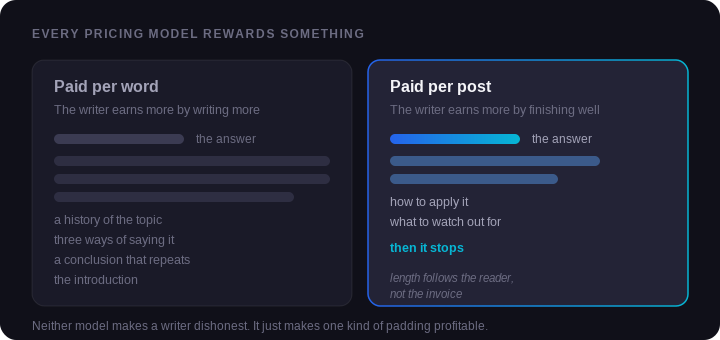
It also puts you and your supplier on opposite sides of every editing decision. Cutting a weak section improves the article and reduces the invoice, so the conversation becomes a negotiation rather than editing.
The same logic applies to per-hour pricing, more mildly: a slow process costs you more than a fast one, and you have no way to tell which you are getting until the invoice arrives.
What actually changes between $30 and $300
This is the question behind the question. Here is what the money buys as the price rises.
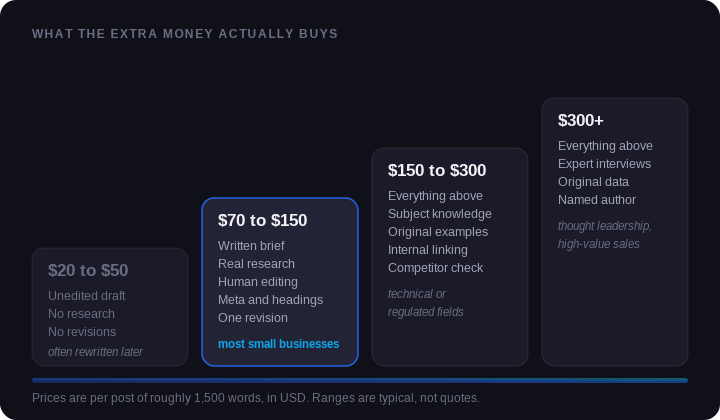
$20 to $50
At this price nobody is researching anything. You are buying a draft, generated quickly or written at speed by someone with no knowledge of your field, with no editing and no revisions. It will read plausibly and say nothing only you could say. Most businesses who buy at this level pay twice, because the piece is rewritten later.
$70 to $150
The useful band for most small businesses. Here you should expect a written brief agreed before anyone starts, genuine research, a human editing pass, heading structure, a meta title and description, and one round of revisions. The writer may not be a specialist in your field, but they will have read what already ranks and they will have checked their facts.
$150 to $300
You are now paying for subject knowledge. A writer who understands your industry needs less briefing, makes fewer errors you have to catch, and produces examples that sound like they came from inside the business rather than from a search. Worth it for technical, regulated or high-value subjects where a wrong detail is expensive.
$300 and above
At this level you are buying original material: interviews with your own experts or customers, proprietary data, a named author with a reputation. This is the right spend for a handful of pages a year, not for routine publishing.
What AI-assisted content should cost, honestly
Any supplier charging $200 for a lightly edited AI draft is overcharging, and any supplier claiming no AI touches their work at any stage is making a claim few can actually support in 2026. Both positions are worth being sceptical about.
The sensible version is explicit: AI produces the first draft against a structured brief, then a human editor checks every factual claim against sources, removes anything unsupported, and rewrites it in your voice. That work is real and it takes time, but it takes less time than writing from a blank page, and the price should reflect that. Expect to pay roughly half to two thirds of the fully human rate.
For reference, our own AI-assisted article is from $70, against from $120 for a fully human-written post. The gap is the drafting time, not the checking.
When AI assistance is the right call: volume work on well-documented topics, straightforward explainers, and updating existing material. When it is not: anything turning on your own experience, regulated or medical subjects, opinion pieces with your name on them, and anything where being wrong carries a real cost.
One more option worth knowing: if the page already exists and simply underperforms, rewriting it starts from $60 and usually beats commissioning a new article, because the page keeps whatever history and links it has already earned.
The scope checklist to take to any supplier
Price only means something next to a scope. Ask every supplier these questions and compare the answers rather than the numbers.
- Is there a written brief agreed before writing starts, covering the angle, the audience and the search it targets?
- Who writes it, and who edits it? If those are the same person, there is no editing pass.
- What is the AI policy? Not whether AI is used, but where in the process, and what human checking follows.
- How are facts checked, and will sources be cited or supplied?
- What on-page elements are included? Meta title and description, heading structure, internal links, schema.
- How many revisions, and what counts as a revision rather than a new job?
- Who owns the copyright once it is paid for?
- What is the turnaround, from brief approval rather than from the enquiry?
A supplier who answers all eight without hesitating is not necessarily the cheapest, but you will know exactly what you are comparing. One who cannot answer them is quoting for something you have not defined, which is how a $35 article and a $300 article end up on the same shortlist.
Two quotes, side by side
A dental practice asks two suppliers to quote for an article on dental implant costs. One comes back at $45, the other at $160. The brief sent to both was two sentences long.
The $45 quote covers a 1,500-word article delivered in two days, with one revision. Asked the checklist questions, the supplier confirms the writer also edits it, there is no brief beyond the title, facts are "researched online", and AI is used for the draft with a proofread afterwards.
The $160 quote covers the same length in five days. The supplier asks who the article is for, whether the practice wants to state its own prices, and which treatments it wants to rank for. They confirm a second person edits, claims about costs and recovery times will be sourced, and the practice's own pricing page will be linked.
The second quote is not better because it costs more. It is better because the questions revealed that the first supplier had not understood that a page about treatment costs in a regulated field carries risk if the figures are wrong.
For a different article, say a piece on how to keep a toothbrush clean, the $45 supplier might be the sensible choice. The lesson is not that cheap is bad. It is that the price only becomes meaningful once you know what sits behind it, and two sentences of brief will not tell you.
A simple way to set the budget
Work backwards from what the page is for. If a post exists to answer a question buyers ask before they purchase, it is worth the mid band and worth revisiting each year. If it exists to cover a topic you need on the site for completeness, the lower end of the useful band is fine. If it exists because someone said you should publish weekly, question whether it needs to exist at all.
Four good posts a year will usually outperform twenty cheap ones, and they cost less in total. The cheap twenty also have to be managed, briefed and eventually rewritten, and that time is rarely counted.
Our pricing, stated plainly
Blog writing is from $120 per post of around 1,500 words, with a written brief, research, human editing, on-page elements and one revision, in five business days. AI-assisted articles are from $70, and rewriting an existing page is from $60. No retainer, no minimum, and the scope is written down before you pay.
See Blog Writing See Content Rewriting